
The Ugly Truth About Love
The Ugly Truth About Love
Tomorrow is Valentine's Day, or as I call it, "Forced Affection Day" (hat tip to Elizabeth Devlin).
You know the drill. Overpriced roses. Heart-shaped boxes of candy nobody wants. Men sprinting through the grocery store at 5:45 PM, grabbing "provisions" to stay out of the doghouse. And most of them land in the doghouse anyway, because the day was set up for failure from the start. Unrealistic expectations, manufactured on a marketing calendar.
Here's a quick illustration. At the pub last night, a woman in a group of three announced, "I just want the Romeo and Juliet romance experience for Valentine's Day!" The other two swooned in agreement.
I couldn't help myself.
"Have you actually read the story? The relationship lasted less than a week, three people were murdered, and both of them committed suicide. Shakespeare filed it under Tragedy."
They picked up their drinks and moved to the other side of the bar.
Figures.
But that little exchange is the whole problem in miniature. The idea of romance implanted in most people's heads is as warped as the story they think they're quoting. We've been sold a fantasy, and then we wonder why real relationships keep failing to live up to it.
So instead of a card and a teddy bear, let me give you an actual gift this year: the thing that almost nobody talks about, the pattern that quietly kills relationships long before anyone says the word divorce.
I know the pattern intimately. It cost me two marriages.
"Wait," you're thinking. "You're twice-divorced, and you're giving relationship advice?"
Yes, I am. Both my ex-wives would agree I earned this education the hard way. I've been to hell and back twice, and I finally figured out why I kept buying the ticket. If reading this saves you from making the same mistake over and over, the way I did for years, then my tuition wasn't wasted.
The Rescuer and The Victim
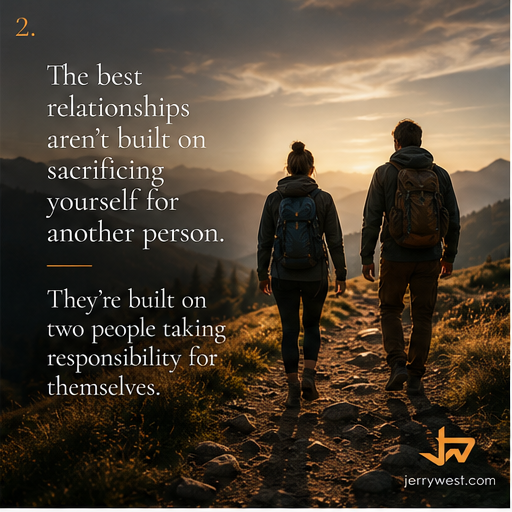
When two victims meet, they create chaos. When two rescuers meet, they create exhaustion. When two accountable adults meet, they create peace.
Most failing relationships I've seen, including my own, run on two roles: the Rescuer and the Victim.
The Rescuer sees himself as the white knight. His job in life is rescuing the other person from whatever peril they've fallen into, and in his mind, the reward for all that rescuing is love, appreciation, and affection.
The Victim has a job too. She manufactures drama to summon the Rescuer because, somewhere along the line, she learned that looking helpless is how you get someone to show up, solve your problems, and hand you the love you're craving.
I'm using "he" and "she" for simplicity, but both men and women play both roles. Crazy has never been sexist.
I thought I had discovered this dynamic on my own, sitting in the wreckage of marriage number two. Turns out a psychiatrist named Stephen Karpman mapped it back in 1968. He called it the Drama Triangle: Rescuer, Victim, and Persecutor, three roles people rotate through in dysfunctional relationships (karpmandramatriangle.com). Mark Manson brought a version of it to a modern audience in "The Subtle Art of Not Giving a F*ck," which is the book that finally made me see my own reflection.
Here's what the pattern looks like in the wild.
The Nashville Story
Back in 2009, during my second marriage, I was in Nashville closing an important business deal. As I usually did, I brought my wife and kids along. They were at the hotel pool about twenty minutes away while I negotiated the deal with my wife's brother, who was my top employee at the time.
Halfway through the talks, my phone starts blowing up. After the third call in a row, I excuse myself and answer.
She's hysterical. All I can make out is that there are people at the hotel threatening to damage her car and threatening her personally. I tell her to call the police immediately. She refuses. Says it will only make things worse. She pleads for her brother and me to come back.
We did. At 110 mph.
When we arrived, the "threatening people" turned out to be a high school church choir group. I am not kidding. They were the nicest kids I have ever encountered, and I'm not exactly a kid person, so that's saying something.
There was no incident. No threats. She made the whole thing up.
Why? To see where she ranked. Would I walk out of an important business meeting to come to her rescue? She started a fire; I grabbed a hose and drove 110 miles an hour to put it out.
Mission accomplished, for both of us.
Now, before you decide my ex-wife was the crazy one, understand this: I was just as sick as she was. Don't be an idiot like I was and spend years pointing at your partner's dysfunction while ignoring your own. That mistake cost me a decade.
We Were Toxic Before We Ever Met
Here's the part that took me years to see. The Victim and Rescuer roles didn't form during our marriage. We each brought them to the first date, fully assembled.
In fact, those roles are exactly why we felt "instant chemistry." She started fires to feel important, and I put them out to feel important. Our dysfunctions fit together like puzzle pieces. Every rescue was a dopamine hit for both of us.
That's not the definition of a bad relationship. That's the definition of a toxic one. And here's the insane part: we saw four different marriage counselors over the years, and not one of them caught it. It's clear as day to me now.
Where do these roles come from? Childhood. That's when the imprinting happens, courtesy of whoever raised you.
"Great, I'll call my mom and yell at her after I finish reading this."
Hang on. Sit down for this part. Yes, the imprint came from your childhood. But staying that way as an adult? That one's on you. Nobody is coming to fix it for you, and blaming your parents is just the Victim role with a different costume on.
If I can own that and fix it, so can you.
What the Trap Looks Like Day to Day
Our marriage didn't fail in one dramatic blowup. It failed in a thousand small exchanges that seemed innocent at the time:
Her: "You used to come home right after conferences. Now you stay extra days. You should be home with your family."
Me: "I can give you a job as event coordinator if that will help you feel more involved in my business."
Her: "You never tell me the names of the people you meet anymore."
Me: "I can't make it to your mom's for dinner. My new staff is struggling, and I have to walk them through this again."
Every one of those lines is a trap. She expected me to take responsibility for her feelings. I volunteered to take responsibility for her problems. Her flower business would struggle, and I'd decide it was my fault for not working hard enough on her website, then push paying client work aside to fix it.
We never once outlined our actual values to each other. She tried to make me happy according to values I never stated. I expected her to make me happy according to values she had never heard. That's a self-defeating relationship, and it's why ours burned down like a dumpster fire two months after Nashville. It took me another year after that to finally show her the door, which tells you how deep the hooks were in me, too.
The Newsflash Nobody Wants
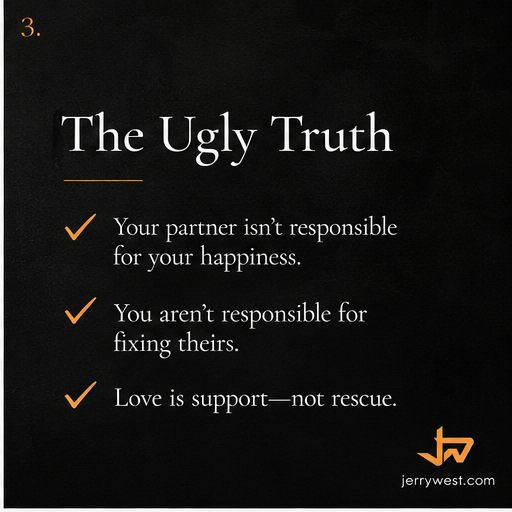
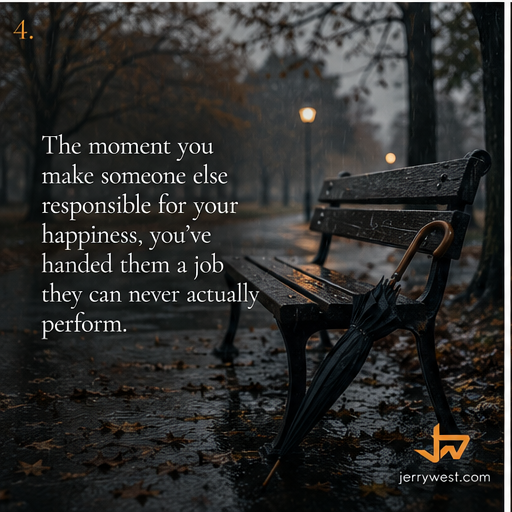
Other people cannot solve your problems for you. Even when they do, it doesn't make you happy. Happiness comes from solving your own problems. And solving your partner's problems won't make them happy either. It just makes them dependent, and makes you resentful when the reward you were secretly expecting doesn't show up.
"So I shouldn't help my partner anymore?"
That's not it. This is about intentions. If you help your partner because you expect to be paid in appreciation, affection, or sex, that's not love. That's a transaction with the price tag hidden. Help because you choose to, with no invoice attached, or don't help at all.
I learned this the humiliating way. When my ex-wife created problems, I solved them. Not because I cared about the problems. If I'm being fully honest, I mostly wanted her to stop complaining, and some delusional part of my brain believed heroics would be rewarded in the bedroom. I was running a transaction and calling it devotion. Don't be an idiot like I was.
What It Sounds Like When It's Done Right
Manson lays out the fix, and it's so simple it's almost embarrassing.
If my wife had said, "I have a problem. You don't have to fix it. I just need you to support me while I fix it myself, and here's what support looks like. Can you do that?"
THAT is a demonstration of love. Full responsibility for your own problem, no blame, and a clear request.
And for my side of it, real love would have sounded like this: "You're blaming everyone else for problems that are yours to solve, and I'm not going to keep rescuing you from them. I'll support you. I won't save you."
That may sound harsh. It isn't.
Telling your partner the truth and refusing to play your half of the toxic game is one of the most loving things you can do, as long as the tone conveys care rather than contempt. There's a difference between a wake-up call and a slap.
Breaking the Cycle
And no, if you recognize this cycle in your relationship, the answer is not divorce. Leave without fixing yourself, and you will hunt down another partner who plays the matching role, because that's who you feel "chemistry" with. You'll rebuild the same house on a new lot. Fix yourself first.
If you've been playing the Victim, the hardest thing you'll ever do is hold yourself accountable for your own problems and stop manufacturing drama to feel worthwhile. One practical step: stop crowdsourcing your relationship. Quit airing grievances on Facebook and quit running to friends and family for verdicts on every conflict.
Bottom Line: Stop recruiting an audience for your relationship. Here's why. The people who love you are not therapists, and they are not neutral. They will take your side almost every time, validate your victim story, and never once ask, "What was your part in this?" That validation feels like support, but it's fuel for the exact pattern that's wrecking your relationship. Keep your friends and family close. Just take your relationship's problems to someone trained to push back on you, or better yet, start pushing back on yourself.
If you've been playing the Rescuer, the hardest thing is to stop rescuing. I know. You've spent your whole life feeling valuable because you save the day. Those fantasies where you swoop in as the hero? Delusion. I ran that highlight reel in my head for years.
Here's the test for whether your "acts of love" are actually love: ask yourself, "If I refused to help my partner with this, would the relationship change? How?"
If the honest answer is a blowup and a storm of drama, you have a problem. Your relationship is conditional, and conditional love isn't love. It's a contract neither of you ever signed.
Acts of love only count when they come without conditions or expectations. That's the fact that changes everything once it sinks in.
The way out for both roles is the same. First, see the roles clearly and admit how they've sabotaged you. Then sit down with your partner and define your actual values. What do each of you really want? Not what you think you're supposed to want. Then set boundaries. Strong ones. Boundaries put each of you in charge of your own problems while leaning on each other for healthy support, which is the entire difference between a partnership and a hostage exchange.
How To Actually Communicate
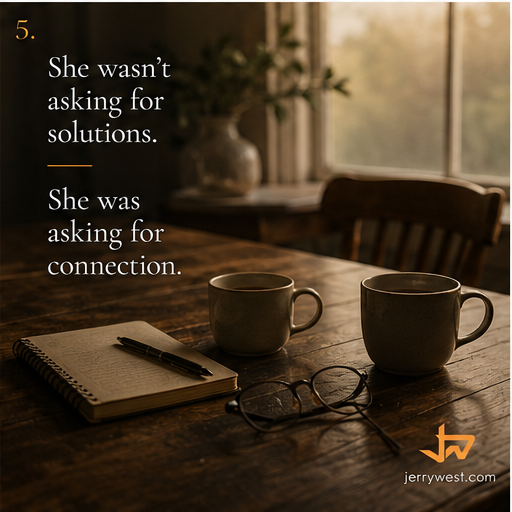
Now, about fixing things when they've gone sideways. Most couples do it in exactly the wrong order. Things get bad, so they either sit down to "hash it out" or book a couples counseling appointment, and then spend the session arguing about wounds neither of them has examined on their own. I've watched that movie. Four counselors, remember? The sessions become a courtroom, each partner litigating, neither one having done a minute of personal work beforehand. Counseling can absolutely help, but it works best for people who have already looked in the mirror. It cannot do the mirror work for you.
So do the work first. Alone.
Go somewhere quiet, preferably early morning. Watch the sunrise and think, really think, about why things are where they are. Put yourself in their shoes. Why have they withdrawn? Why do they seem shut down? Why has intimacy become a struggle? Look at your own recent behavior. Have you been sending mixed signals? Could their distance be self-protection from the hurt you caused? Could it be work stress, family stress, something that has nothing to do with you at all?
Seriously. It isn't always about you.
Once you have real reasons backed by real examples, go to your partner and say: "I know things haven't been great between us lately, and I've been thinking hard about what caused it. Can we sit for a few minutes so I can share what I came up with?"
Notice what's missing: "Hey, can we talk?" That phrase is the universal air-raid siren of relationships. Guard goes up, gloves come on. What we're doing instead is direct, clear, and safe.
The Standing Date
Let me show you this in action.
A few years back, a couple of months into dating someone, we hit a snag. I was out of town on business, and we had a standing date for the night I returned. When I got back and texted her, she said she was busy. Maybe another time.
My first reaction: she's being rude. We had plans. No notice, no explanation. I was pissed, and honestly, you probably would have been too. Long trip home, looking forward to a relaxing evening, and instead I've got a dinner date with my laptop at the pub.
Halfway through dinner, a thought elbowed its way in: "What if this is YOUR fault?"
My ego said no chance. But I started actually processing it, putting myself in her shoes, and the mixed signals I'd been sending came into focus one by one. A few beers and many pages of notes later, I could see exactly why she did what she did. Was her move right? No. She didn't communicate at all. She went into protection mode. But I had handed her the reasons.
I called her the next day. Told her I'd been thinking about it, believed I understood why she broke our date, and asked if I could share what I'd found.
"Fine, go ahead," she quipped.
Everyone knows that tone. But I was confident, because I had done the work. I laid it all out. Every mixed signal, every way I had contributed, in as much detail as I could. Then silence on the line. Long, uncomfortable silence. I let it sit.
Then a soft voice: "Oh. My. God. You get it. You understand. You really get it. I can't believe it."
THAT is how you repair a miscommunication. Not "let's talk." Not "tell me why you're upset." Not flowers, grand promises, or a big apology speech. You do the work, project yourself into their experience, write down where you failed, confirm you've got it right, and then show the change rather than announce it.
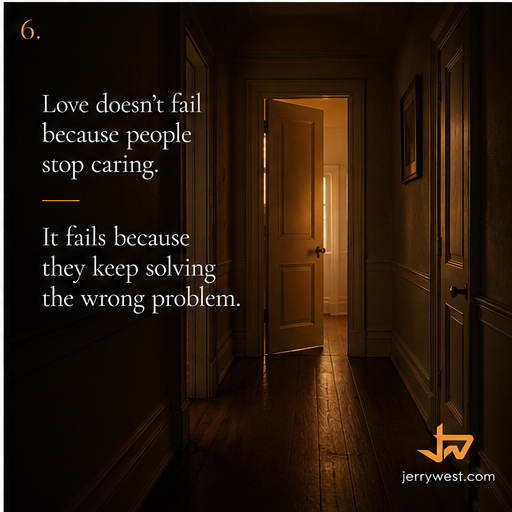
And here's the beautiful part you're wondering about: what about her role, her responsibility? Once real communication enters a relationship, the other person seizes it. They open up too. It's a natural response to finally feeling understood. That's the door opening for both of you to fix things for the long term.
Your Reward for Doing the Work
I'm sure right now you're thinking, "Jerry, this all sounds good, but what do I actually get out of it?"
Here's what you get. The fear goes away.
Imagine finally being able to exhale. No second-guessing every word. No rehearsing hard conversations in your head. No wondering whether honesty will cost you the relationship.
Imagine vulnerability that isn't ammunition for the next argument, but an invitation to be understood.
Imagine trust becoming so ordinary that you forget it's there. People don't notice oxygen until it's gone. Healthy trust works the same way. It's invisible.
None of this eliminates conflict. It changes what conflict is for. The relationship stops being a courtroom where somebody has to be guilty and becomes a workshop where two people build something neither could build alone. You assume your partner misunderstood you rather than that they meant to hurt you. You get curious before you get certain. You ask before you accuse. You repair instead of retaliating.
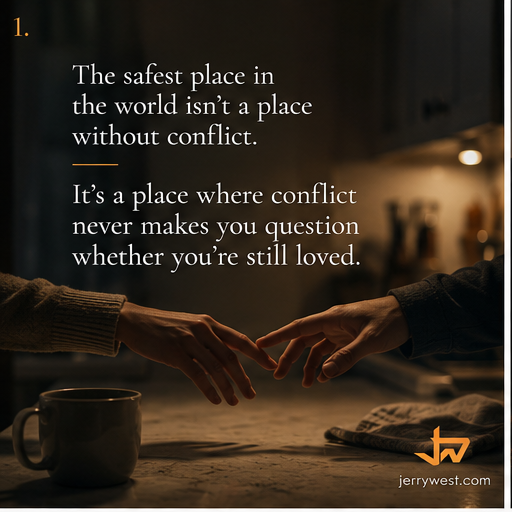
The safest place in the world isn't a place without conflict. It's a place where conflict never makes you question whether you're still loved.
The Short Version
Love is what you DO, not what you say.
Trust is what you PROVE, not what you promise.
Sorry is how you CHANGE, not how you apologize.
It's not about giving a damn about everything your partner gives a damn about. It's about giving a damn about your partner, regardless of what he or she gives a damn about.
Read that again.
THAT is unconditional love. Learn to love like that, and you can have the relationship you've always wanted. Hell yes, you can.
Rock on.

Previous

Life Isn’t Fair; And That’s Okay