
The Ugly Truth About Love
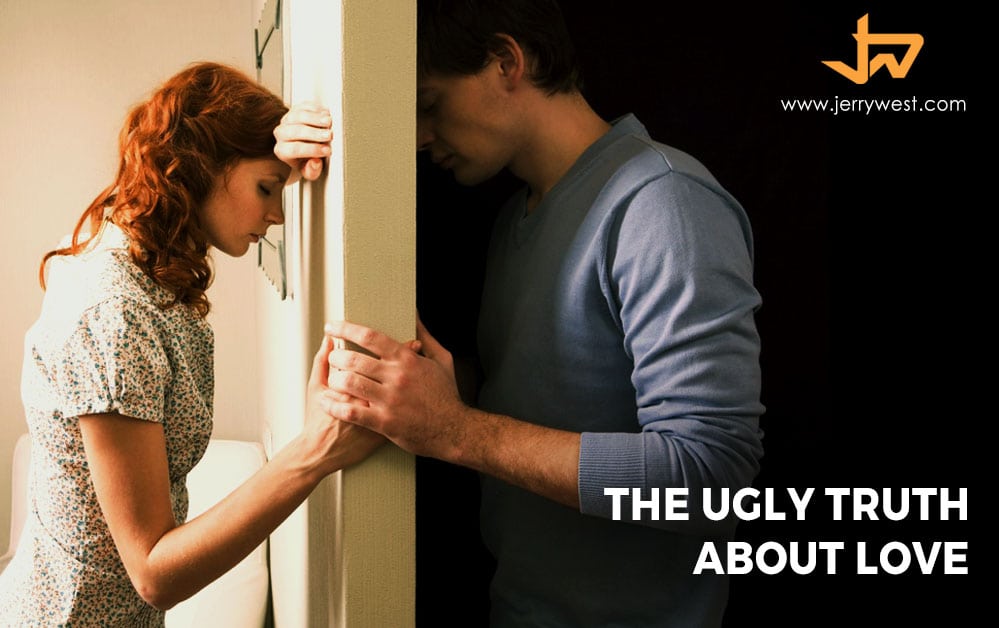
Tomorrow is Valentine's Day, and I call it "Forced Affection Day" (hat tip to Elizabeth Devlin). That is a fact. And every year the same situation unfolds. Nearly every woman in the world is swooning, and nearly every man is groaning. For good reason. It is a "holiday" set up for failure.
It's due to unrealistic expectations.
The overpriced roses, candy, and teddy bears. It could be an Olympic sport, seeing the men dashing to the store on their way home from work today to pick up the needed "provisions" to stay out of the proverbial doghouse.
But odds are, despite their good intentions, they will fall short of expectations and wind up in the doghouse anyway.
Allow me to illustrate.
Exhibit A: While at the Pub tonight, in a group of three women, one said, "I just want the Romeo and Juliet romance experience for Valentine's Day!"
The other two giddily agreed.
I couldn't contain myself.
"You want what?!?! Have you EVEN read the story?"
"Of course I have, silly," she quipped back. "It is a beautiful and romantic story, and it's every woman's dream."
"What are you talking about?!?! The relationship lasted less than a week, three people were murdered, and Romeo and Juliet each committed suicide. Is that your idea of romance?!?!"
They each picked up their drink and moved to the other side of the bar.
Figures. The takeaway is that the idea of romance implanted in people's minds worldwide is as warped as the story of Romeo and Juliet. If Shakespeare were alive today, he would have described them as "cray-cray."
After all, Romeo & Juliet is referred to as a Tragedy.
But I digress.
Just stop celebrating this "holiday" already.
Why do you succumb to the marketing machine that dictates when you should be romantic and affectionate? The word "should" is toxic. YOU choose when you do things, not because the calendar says so.
If you have a significant other, they should already know you think they're awesome because you tell them and show them on your terms, not by the calendar.
That's how it should be.
Damn. I just used the word "should."
And before you think that if you throw Valentine's Day in the dumpster fire, your relationship will be hell, let me give you a gift.
Fixing yourself and your current relationship.
"What?" you're thinking. "Jerry, you're twice-divorced, and you're going to give relationship advice?"
Yes, I am.
Look, both my ex-wives hate my soul, so who better to give you advice than someone who has been to hell and back TWICE and not only lived to tell about it, but came out more awesome. ;)
It's true.
Let's talk about the divorce rate. It's around 50%, and that takes into account first, second, third, fourth, and, yeah, fifth marriages.
It's high. Higher than it should be.
Why?
Because half of the people in the world typically fall into one of two categories: a Saver or a Victim. And I don't mean a "saver" in a financial sense, but in a dependent, crazy sense. And both men and women can take on either role.
Face it, crazy isn't sexist. It never has been.
So that we are on the same page: "Savers" are those who see themselves as "white knights" and view their role in life as "saving" the other person (the Victim) from the "peril" they have fallen into. And by doing this, the Saver will receive (in their mind) love, appreciation, and/or sex from the Victim as their "reward."
The Victims have their role too. They manufacture drama to get the attention of the Saver because they believe that if they look like the helpless victim, someone will come along to solve their "problems" and give them the love, romance, and/or sex that they crave.
If this sounds at all familiar, keep reading. You CAN fix this.
Let me give you an example from my life that you might relate to.
Back in 2009, when I was married (second wife), I was in Nashville closing an important business deal. It's a great city, and you should definitely visit. Day drinking on Broadway is the best.
Wait, I'm getting distracted now, where was I?...
Oh yeah, as I normally do, I brought my wife and kids with me. They were at the hotel pool, about 20 minutes away, while I negotiated the deal with my wife's brother, who was my top employee at the time.
About halfway through the talks, my phone starts blowing up from my wife. After the third call in a row, I excuse myself into the hallway and take the call.
She's hysterical.
All I was able to make out from her hysterics was that there were people at the hotel making threats to damage her car and threatening her personally. I advised her to call the police immediately. She refused, saying it would only make the situation worse. She pleaded for her brother and me to return to the hotel.
We did. At 110 mph.
When we arrived, we were greeted by a sight I did not expect. The "threatening people" my wife warned me against was a high school church choir group. I'm not kidding. They were the nicest kids I'd ever run into.
"What the hell," I said out loud, and my brother-in-law concurred. They were hands down the nicest group of kids, and I hate kids. The emphasis here is on kids.
To wrap up the dramatic story, there was no incident involving threats. She made it up. She did it to get me to come back to her. She wanted to see where she mattered in my life. Where my priorities were. Would I leave an important business meeting to come to her rescue?
Dear God and Baby Jesus. It would take more than a year for me to finally show her the door.
Now, before you go thinking my ex-wife was crazy, I had a big part in this, too.
It's true.
We were both messed up.
Let me further explain, and it just might shed so much light on your current or past relationships that you say out loud, "THAT'S it!!!" And a hat tip to Mark Manson and his book, "The Subtle Art of Not Giving a F*ck," for bringing to the forefront how messed up I truly was.
You see, the roles of Victim and Saver between my wife and me did not form during our marriage. We had those roles BEFORE we met.
In fact, that is the main reason why we were attracted to each other and felt "instant chemistry" on our first date.
She started fires to get my attention and make her feel important, and I put them out because it made me feel important. Our dysfunction fed off each other and gave us emotional highs. That dopamine hit.
Now, to be clear, that isn't the definition of a bad relationship; it is the exact definition of a TOXIC relationship.
We were toxic, but we just couldn't see it.
And the insanity of this is that even though we saw four different marriage counselors during our time together, not one of the therapists saw this. And it is clear as day to me now.
We both used each other as a means of escape. We took no responsibility for our own problems and instead took responsibility for each other's problems. This means we had no boundaries. While you may think that was sweet and considerate of us to worry about each other, it was based on selfishness and insecurity.
This is what our relationship looked like:
Her: "You used to come home immediately after conferences out of state, now you stay a few more days away from us. You should be home with your family."
Me: "I can give you a job as event coordinator if that will help you feel more important and involved in my business."
Her: "You never tell me the names of the people you meet at conferences. You used to, but now I never get names anymore."
Me: "My new staff is struggling. I am not going to be able to make it to your mom's for dinner; I have to explain this process to them once again."
Some of these may seem innocent enough, but they are rife with Victim and Saver roles, which create "traps" in the relationship.
First, she expected me to take responsibility for her problems. I'd come home from work and would have consulting calls scheduled. "I wanted a nice, relaxing night at home with you; you should have known that and not scheduled work."
Or, in my case, I would take on too much responsibility and take on her problems: "Her flower business is struggling, but it is probably my fault because I didn't work hard enough on her website to get her better rankings and more leads. I'm going to push client work aside and work on her site all day tomorrow."
Our problem is that we didn't outline our respective values. Instead, she either focused on making me happy per her unstated values, or I expected her to make me happy based on my unstated values, and vice versa.
That is what we call a self-defeating relationship, and the reason our relationship burned to the ground like a dumpster fire as we were separated just two months after the incident aforementioned.
Newsflash: People can't solve your problems for you because even if they did, you wouldn't be happy.
This is a fact.
You might think they would, but they don't. Happiness comes from solving YOUR OWN problems. The same goes for you trying to solve other people's problems because it won't make them happy either.
If you are thinking, "So, I shouldn't help my partner with their problems anymore?"
No, you idiot. That isn't what this is about. This is about your intentions. If your focus is to solve your partner's problem, because if you do, you'll feel important and even be rewarded with sex or other extra attention, THAT is the problem. You should do it because you CHOOSE to, not because there is something in it for you.
Get it now?
Back to my ex-wife and me.
We failed to meet each other's needs because we never clearly stated our needs to the other person. We both had horrific self-worth, and our communication was near non-existent. We would avoid each other. She would go to bed early, and I would stay up late playing Madden or working. I'd spend more time than I needed to at the office, and I'd extend business trips for the sole purpose of avoiding time at home.
What happened was that she created more and more problems for me to solve, not because they were real, but because she just wanted my attention. She craved affection. And instead of her communicating her need or me being aware of it, I was an idiot and solved every problem I could. Not because I actually cared about her problems, and since I'm being open about it, I was more interested in getting her to shut up and stop complaining about ridiculous things. And to showcase how much of a delusional idiot I was, I actually thought doing this would also get me sex.
It's true, and yes, I'm quite embarrassed by my dumb-assness.
Mark Manson sums up perfectly how we could have fixed our issues, and how you can fix yours.
Seriously, it's this simple.
If my wife had said, "I have a problem, you don't have to fix it for me, just support me while I fix it myself, and this is how you can best help me. <outlines support needed> Can you do that?"
THAT would be a demonstration of love: taking full responsibility for your own problems, not blaming your partner, and outlining how you want support.
See? That's not hard.
For me, if I really wanted to save my wife from all the negativity she was feeling, I could have said, "You're blaming others for your own problems, but you are responsible for your own problems, and dealing with them yourself is the answer you are avoiding."
While that may seem like a crass and insensitive move, it isn't. It shows love when you clearly and distinctly tell your partner to solve their own problems and stop playing the Victim role, while at the same time stopping the Saver role within yourself.
See? Coming across as an ass isn't always a bad thing. Well, it can be, and it is all in the tone in how you say it. I shouldn't have to explain this further. You get it.
And this isn't to say that if you currently fall in this cycle, the best choice is divorce. That would be stupid. Why, you ask?
Because you will end up attracting the same type of person as before, and you'll just end up in the same situation.
You have to fix yourself FIRST. Break the cycle!
If you have played the Victim role, the hardest thing for you is to start holding yourself accountable for your problems and to stop making up drama to feel worthwhile.
One of the best things you can do is stop posting anything personal on Facebook or talking to family or friends about your marriage/relationship. This is going to be absolutely terrifying for you, but it is the only way to have the relationship that you want and stop self-sabotaging it.
If you are in the Saver role, the hardest thing for you is to stop trying to rescue everyone, including your significant other. I get it, you have spent your whole life feeling valued by saving other people, coming to the rescue, saving the day, etc. And those constant fantasies in your head that you miraculously are the hero are based on delusion.
Yes, delusion.
Fact: Acts of love are only valid if they are done without conditions or expectations.
If you're a Saver, how do you know the difference between acts of love done with conditions and expectations or without?
Just ask yourself one question: "If I refused to help my significant other, would the relationship change? If so, how?"
Now, if the answer is a major blowup and a lot of drama, then you have a problem. A big problem. Your relationship is conditional and could be borderline toxic.
The solution is to first recognize which role each of you plays and see how it has sabotaged your relationship. The clearest way to see this is to realize you aren't getting out of the relationship what you expected, but you still love each other.
Want to know a secret?
There are A LOT of couples that divorce that still love each other, but they don't know how to get past their own issues and get out of the toxic "Saver" and "Victim" roles.
I'm here to tell you that you can.
Next, come up with agreed-upon values with your significant other. What do each of you want? I mean, REALLY want. Then set boundaries. Strong boundaries. Doing so puts you in control of fixing your own problems while leaning on your partner for healthy support when you need it, instead of expecting them to fix things for you.
If your relationship is in trouble, one of the worst things you can do is sit down with your partner and "hash things out," or even worse, do that in front of a therapist.
Why? Because you're going to probably end up defensive and say things you'll regret later.
Instead, do some work. Real work. Go somewhere quiet, preferably first thing in the morning. Watch the sunrise and think, really think about WHY you are in the situation you're in.
Put yourself in their shoes. Why have they become withdrawn? Why do they seem emotionally shut down? Why has intimacy been more of a struggle?
Look at your behavior lately. Have you been sending mixed signals? Could their behavior be them protecting themselves from future hurt? Could it be work stress? Extended family stress? You know, it isn't always about you.
Seriously, it isn't always about you.
Once you come up with some solid reasons, backed with examples, you can go to your partner and say, "Hey, I know things haven't been exactly great between us lately, and I've been thinking about what has caused them. Can we sit for a few minutes, and I can share with you what I've come up with?"
Notice that nowhere in that exchange did I say, "Hey, can we talk?" which is the universal language of GET READY TO RUMBLE!!!!! Right? That's not what we are doing here. This is about direct, clear, and compassionate communication.
By doing this, your partner's guard won't go up; it will feel different. One woman I was dating described it as "safe" and something she had never felt before when discussing problems in a relationship. Because it feels safe, you can then focus on how you perceive they are feeling, what you did to bring that about, and what you'd like to do so it doesn't happen again. If you do the work, you will often be spot on, and your partner will be shocked by how well you understand.
Let me give you an example. It had only been a couple of months of dating, and we hit a snag. I went out of town on business, and we had a standing date the night of my return. However, when I returned and texted her, she said she was busy, and we could get together another time.
My first reaction was that she was rude. We had a standing date, and instead of giving me some notice, she made other plans and didn't tell me. I'll be honest, I was pissed. You probably would be too if you were in the same situation. It was a long trip back, and I was looking forward to a relaxing evening with her. Instead, I would have a date with my laptop at the pub.
About halfway through my dinner at the pub, a thought entered my head, "What if this is YOUR fault?!?!" Yeah, right. She's the one who blew off our date. But as I started to process things, putting myself in her shoes, I could start to see the mixed signals I had been unknowingly sending.
After a few beers and many pages of notes written out, I could clearly see why she did what she did. Was it right? No. She did not communicate clearly. Well, she didn't communicate at all. Instead, she was in protection mode and proceeded accordingly.
When I called her the next day and said I had been thinking about things and felt I had a good idea why she broke our date, and asked if I could share my findings.
"Fine, go ahead," she quipped.
Everyone knows that response isn't good, but I was confident. I had done the work. I had placed myself in her shoes and run back the tape in my head of all my mixed signals. I laid it out for her. Everything. In as much detail as I could. The other end of the line was quiet. I let the quietness be. It got to the point where it was really uncomfortable.
Then I heard a soft voice, "Oh. My. God. You get it. You understand. You really get it. I can't believe it."
And THAT is how you attempt to fix a miscommunication in a relationship. You don't say "let's talk" or "tell me why you're upset." No, you do the work and project in your mind how it would feel in their shoes. Write down how you failed and how you are going to fix that moving forward. Not loving words, not grand promises, not a big apology. Identify the issue, confirm with her that's the issue, and show her, don't tell her, the change so it doesn't happen again.
Now I know what you are thinking. What about her role in this? Where is her responsibility? This is the beautiful part. Once real, effective communication is introduced into a relationship, the other partner seizes it. They will begin to open up, too. It is just a natural occurrence.
This will open the door for both of you to fix your relationship in the long term.
In short:
Love is what you DO, not what you say.
Trust is what you PROVE, not what you promise.
Sorry is how you CHANGE, not how you apologize.
Trust is what you PROVE, not what you promise.
Sorry is how you CHANGE, not how you apologize.
You see, it's not about giving a damn about everything your partner gives a damn about; it's about giving a damn about your partner regardless of what he or she gives a damn about.
Read that again.
THAT is what unconditional love is.
If you can learn to love like that, your relationship will be solid. Hell yes, it can.
Rock on.

Previous

Life Isn’t Fair; And That’s Okay